
Ask a contractor what kind of government information it handles and the answer tends to arrive in one of two forms. Some say they don’t handle any government information, certain that nothing they touch is sensitive enough to count. Others say they handle multiple types of government information, believing that anything with a government logo on the cover must be locked down like a secret.
Both answers feel safe, and they're both usually wrong. The first leaves a contractor exposed to requirements it never planned for, while the second sends it chasing a program far larger than the contract demands, at a cost that shows up in the budget for years. In the CMMC space, what separates them is a pair of definitions that most contractors have never read closely: Federal Contract Information (FCI) and Controlled Unclassified Information (CUI).
Let’s first look at Federal Contract Information.
What is FCI?
Federal Contract Information (FCI) is information, not intended for public release, that is provided by or generated for the Government under a contract to develop or deliver a product or service to the Government. The definition comes from the Federal Acquisition Regulation (FAR), and it carries two exclusions: information the Government provides to the public, such as on a public website, and simple transactional information, such as what is necessary to process payments.
You will sometimes see people search for federal contracting information, which is close enough to find the right answer, though the regulatory term is Federal Contract Information and it is worth using the exact words in a System Security Plan or a conversation with a prime.
In practice, almost any contractor performing under a Department of Defense (DoD) contract holds some FCI, whether it takes the form of statements of work, schedules, pricing, or performance data. None of it carries a special marking, which is part of why contractors overlook it, because nobody stamps it. It is simply the ordinary business information of working for the Government, and the regulation says it requires protection.
FCI vs. CUI: what is the difference?
Start with the second definition. Controlled Unclassified Information (CUI) is information that the Government creates or possesses, or that a contractor creates or possesses for or on behalf of the Government, that a law, regulation, or Government-wide policy requires or permits an agency to handle using safeguarding or dissemination controls. In the CMMC space, this is often referred to as CDI or CTI.
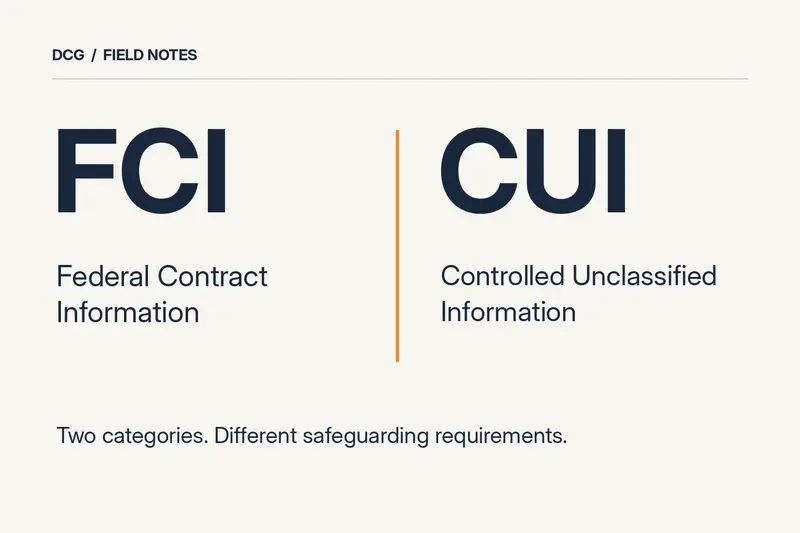
Read the two side by side and the relationship becomes clearer. FCI is the broad category, covering nearly everything a contractor holds because of a contract, while CUI is the narrower one, the portion where a law, regulation, or Government-wide policy calls for specific controls. Most of what a contractor holds is FCI, and only a part of it is CUI.
The practical difference comes down to who decides. A contractor does not declare something CUI because it feels sensitive, and it does not declare something exempt because the controls would be inconvenient. The Government designates CUI and the contract identifies when it applies. If you want a more in-depth discussion of that second term, our post on what CUI is walks through it in plain English.
Why do contractors get this wrong?
Two errors account for most of what we see, and they run in opposite directions.
- The first is assuming you hold no CUI, which is common and dangerous, because the contractor builds nothing and learns otherwise during a prime's review or an assessment.
- The second is assuming everything is CUI. That's usually the more expensive mistake. Treat every file and system as CUI and you pull your entire environment into scope, paying to protect information that never required those controls.
Both errors have the same source: nobody sat down with the contract and sorted the information, so the contractor guessed, and a guess in either direction costs money. That sorting is the first step of what we call CUI Discovery.
Why does the answer set your path?
Because each type of information comes with its own security requirements, and each maps to a different CMMC level.
- CMMC Level 1: A contractor that handles only FCI follows the 15 basic safeguarding requirements in FAR clause 52.204-21, which corresponds to CMMC Level 1. They must file a no-fail self-assessment every year.
- CMMC Level 2: A contractor that must handle CUI implements the 110 security requirements in NIST SP 800-171 Rev 2, measured by 320 assessment objectives. Under 32 CFR Part 170, known as the “CMMC Rule,” they may have to submit to a third-party assessment (C3PAO) every three years and submit yearly self-attestation based upon the CMMC level required in their contracts. However, the DoD CIO paused that piece of the regulation via a class deviation memo while they look into the program. At this time, contractors must only submit a self-assessment every three years and attest to it being accurate and still “current” every year. To understand current better, read our blog about what is considered a significant change.
The distance between those two levels is large. Level 1 asks for 15 basic practices, whereas Level 2 asks for a documented, evidenced program, and from a standing start that journey takes roughly 18 months. A contractor that wrongly assumes it needs Level 2 spends years on a program it never required, and one that wrongly assumes Level 1 finds out when the contract arrives, which is the worst moment to learn it.
Once the scope is settled, a CMMC gap assessment measures where you stand against it. For some contractors, a managed enclave shrinks the CUI footprint enough to change the whole budget, a model we cover in our post on why Midwatch is not an MSP, and the question that follows, how CUI gets printed and scanned out of that enclave, is the subject of our post on secure printing for CMMC.
How do you find out which one you handle?
Start with the contract. The contract and the clauses it incorporates tell you what the Government expects you to safeguard, and the markings on documents you receive tell you the rest. When the picture is still unclear, ask the contracting officer or the prime in writing, and ask whoever is advising you, whether a Registered Practitioner or a consultant, to show you where in the contract their conclusion comes from, because a defensible answer points to a document.
A contractor that cannot say which kind of information it handles cannot say which program it needs, and everything after that, the budget, the timeline, and the assessment itself, rests on a guess.
You cannot stand a watch over information you have not yet identified.