
Consider a contractor that has done the early work right. It knows which contracts require it to handle Controlled Unclassified Information (CUI), it has traced the data flows, and it has drawn a boundary around the systems that touch that information. It has also filed a self-assessed score of 104 in the Supplier Performance Risk System (SPRS), and its leadership reads that number as a sign the hard part is behind them.
I understand why. A 104 is a real number, earned through real work, and the people who produced it believe it.
But a score filed against the 110 controls says very little about how the same program will hold up when someone outside the company reads it against the 320 assessment objectives underneath them. That second reading is what a CMMC gap assessment produces, and it is usually where the 104 starts to come apart.
What is a CMMC gap assessment?
The Cybersecurity Maturity Model Certification (CMMC) is the program the Department of Defense (DoD) uses to verify that contractors protect the information it trusts them with. Many people still call it CMMC 2.0, and the requirements you face depend on the CMMC level your contracts name.
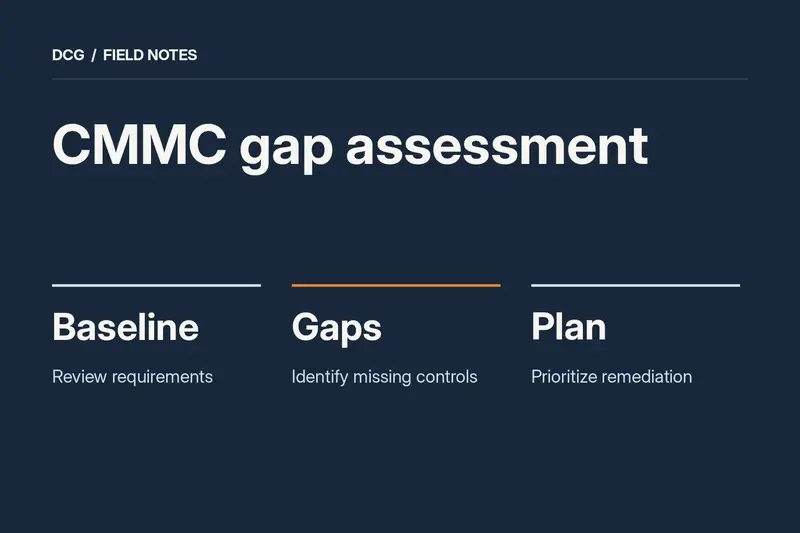
A CMMC gap assessment, which you will also hear called a CMMC gap analysis, is the formal, full-scope inventory of where a contractor stands against all 110 controls in NIST SP 800-171 and all 320 assessment objectives in NIST SP 800-171A. It produces a scored read of the contractor’s position, and it pairs that read with a remediation plan that turns every finding into a sequence of work.
The objectives are where compliance is validated. The controls establish the requirement. The assessment objectives define how that requirement is evaluated. A control is a headline; the objectives beneath it are what an assessor actually checks, one at a time. A program that addresses every control without working to the objectives will fail, because the assessor will not assess the headline: The 320, not the 110.
What has to happen first?
A gap assessment measures a program against a boundary, so the boundary has to exist before the measurement means anything. That is why our engagements begin with CUI Discovery, where we work from the contract language and the actual data flows to settle what CUI the contractor has and where it lives. Scoping follows, and it pulls in systems that store, process, or transmit CUI; assets that provide security protections to those systems; and in-scope assets identified through the applicable CMMC scoping guidance.
If you are still sorting out what qualifies, our posts on what CUI is and on how Federal Contract Information (FCI) differs from CUI are the place to begin. Run a gap assessment before that work is done and you end up scoring a guess.
What does the work actually look like?
Once the boundary is set, the assessment walks every objective in order, and for each one it asks three questions.
Is the practice implemented everywhere it applies? Is it documented in the System Security Plan (SSP) and the policies and procedures behind it? Is there sufficient evidence for an independent assessor to determine the objective is satisfied?
Take access controls, which nearly every contractor believes it has handled: a company may have a clear policy saying administrator privileges go only to the people who need them, and a technical setting that enforces it on most systems. The objective underneath asks something harder: how do you know, today, who holds those privileges, and when were they last reviewed? If the honest answer lives in one person’s memory, that objective has no defensible answer, however good the policy reads. Be sure the response is demonstrated through documentation, system configuration, or other objective evidence, so the organization can support that objective during an assessment.
That is the level of detail at which a gap assessment has to identify gaps, and it is why this work takes time. Each compliance gap gets scored, described, and tied to the specific objective it affects. In my experience, the biggest value is the stuff the contractor missed and had no idea was a problem.
What comes out the other end?
The deliverable has two halves. The first is the scored read, with every objective evaluated, supported by documented findings and ultimately marked met or not met. It also identifies gaps in the System Security Plan and plainly documents any missing evidence required to support compliance.
The second is the remediation plan, which sequences the work by risk rather than by control number, so the most serious threat to the organization’s security posture gets fixed first, an ordering we call Risk-First Triage.
The remediation plan is built as a Plan of Action and Milestones, and a full gap assessment maps every gap it finds into it. Plans of Action and Milestones (POA&Ms) are required for known deficiencies under NIST SP 800-171, and they are the working record of who closes what, and by when. Each objective also gets a named owner, which is the artifact we call the Watch Bill.
At assessment time, though, a CMMC POA&M means something much narrower: only a short list of eligible, lower-weighted requirements may still be open when you are assessed, the no-fail controls never qualify, and anything that does qualify has to close within 180 days.
Your gap assessment will put every gap on your plans of action, but that does not mean every gap may stay open at assessment. A good gap assessment tells you which of yours can use that allowance and which have to be closed first, and our post on CMMC compliance versus certification covers why close does not count.
How is this different from a readiness review?
The two sound alike, but they do different jobs. A Readiness Review is the faster diagnostic. It identifies the key control gaps and gives an honest read of a contractor’s readiness status, which is often all a company needs to decide its next move.
A CMMC gap assessment is the deeper and slower one. It covers all 110 controls and all 320 objectives, maps every gap into the POA&M, and becomes the document you build the program from. Because it is built to that depth, it takes longer than a Readiness Review; what you buy with the extra time is a plan you can staff and budget against line by line.
A Mock Assessment comes much later, as a rehearsal run in the format a C3PAO will use, once the program is ready to be tested. People sometimes lump all three together as a CMMC audit or a CMMC assessment, but each answers a different question: roughly where do I stand, exactly where do I stand, and will I hold up under pressure.
Why not just start building?
It is a reasonable instinct. Contractors that handle CUI have been required to implement NIST SP 800-171 since 2017, so many feel they already know what to build, and measuring first can feel like paying for a delay.
Consider what building first tends to produce. Budgets drift toward technology because technology is visible and purchasable, while documentation is slow and unglamorous. Yet roughly seventy percent of CMMC compliance lives in the documentation, and a program that spends ninety percent of its money on tools has its cybersecurity compliance upside down before the first control is configured.
Time matters as well. From a standing start, the journey to certification is roughly 18 months, and anyone who promises thirty days is selling a product that does not exist.
A gap assessment leaves the amount of work exactly where it was; what it removes is the guesswork, so the work can be budgeted, sequenced, and defended. For the broader picture of the mandate, our post on what CMMC actually requires covers it in full.
Who should run it?
Very small mistakes in how an objective is interpreted produce assessments that blow up in a contractor’s face, so the person scoring yours should understand how an assessor reads them. We pair experienced CMMC practitioners, including Certified CMMC Assessors (CCAs) and Certified CMMC Professionals (CCPs) with a technical writer for that reason: one owns the interpretation of each objective, and the other owns the artifacts that prove it.
A gap assessment is also worth repeating whenever your environment shifts in a way that moves the boundary, such as a new system that touches CUI, a new prime with different requirements, an acquisition, or a move to a new cloud platform. When that happens, revisit discovery and scope first, then measure again.
The contractor with the 104 did not do anything foolish. It did real work and reported an honest number.
What it lacked was a reading of that work at the level an assessor will use, with every gap named, owned, and placed in order. Approached is not cleared, and the only way to know how far you have to go is to measure it.
The watch never ends, but it has to start somewhere, and it starts with knowing where you stand.